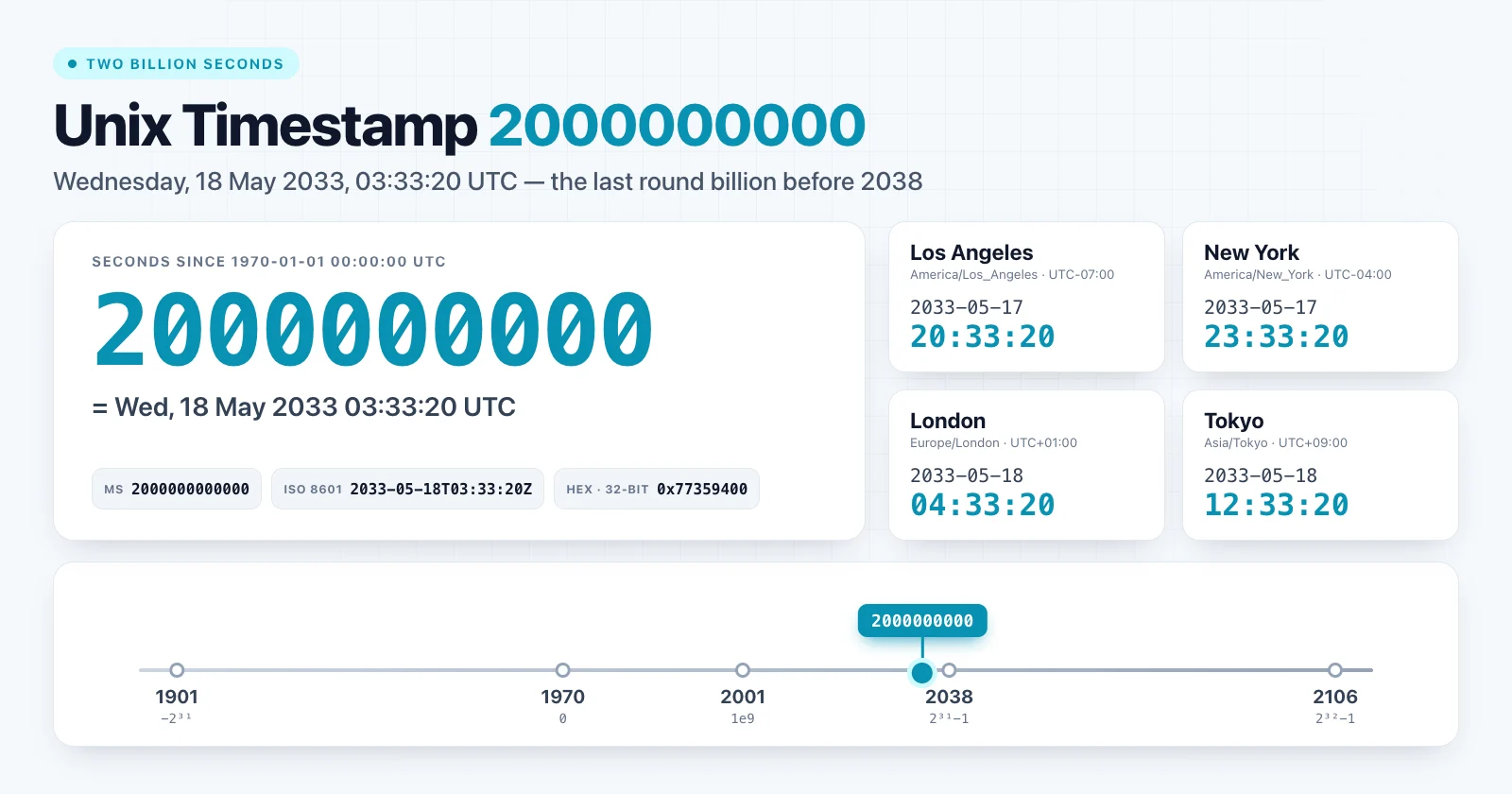
Unix timestamp 2000000000 is Wednesday, 18 May 2033, 03:33:20 UTC. It is the second round billion of Unix time, and the last one a signed 32-bit integer can hold.
It matters less as a date and more as a warning. Two billion seconds is only about four years and eight months away from the Year 2038 limit at 2147483647. Any system that calculates dates a few years ahead will cross that limit long before the calendar reaches 2038.
Unix timestamp 2000000000 at a glance
| Format | Value |
|---|---|
| Unix seconds | 2000000000 |
| Unix milliseconds | 2000000000000 |
| ISO 8601 (UTC) | 2033-05-18T03:33:20Z |
| RFC 1123 | Wed, 18 May 2033 03:33:20 GMT |
| Day of week (UTC) | Wednesday |
| Hex (32-bit) | 0x77359400 |
Check it in the Unix Timestamp Converter.
2000000000 in different time zones
| Location | Local date and time | Offset |
|---|---|---|
| Los Angeles | 2033-05-17 20:33:20 | UTC−07:00 |
| New York | 2033-05-17 23:33:20 | UTC−04:00 |
| London | 2033-05-18 04:33:20 | UTC+01:00 |
| Berlin | 2033-05-18 05:33:20 | UTC+02:00 |
| Kolkata | 2033-05-18 09:03:20 | UTC+05:30 |
| Tokyo | 2033-05-18 12:33:20 | UTC+09:00 |
| Sydney | 2033-05-18 13:33:20 | UTC+10:00 |
These local times are based on today's time-zone rules. Governments change daylight saving rules from time to time, so local times for dates years in the future can shift. The UTC value never changes. That is one more reason to store future instants as Unix timestamps or UTC, and convert them to local time only when displaying them.
How far is 2000000000 from the 2038 limit?
The largest signed 32-bit integer is 2147483647, which is 2038-01-19 03:14:07 UTC. The distance from two billion:
2147483647 - 2000000000 = 147483647 seconds
                        ≈ 1,707 days
                        ≈ 4 years and 8 months
In other words, 2000000000 is safe, but not by much. If a system stores Unix time in a 32-bit signed integer, the last day it can represent is less than five years after this milestone.
The 2038 problem arrives early for future dates
The Year 2038 problem is often described as something that will happen "in 2038". For many applications it happens sooner, because they work with dates in the future:
- Expiry dates. A token, certificate, license or cookie that is valid for 10 years, issued in 2029, expires after 2038.
- Subscriptions and billing. A multi-year contract or payment plan starting in 2034 ends after the limit.
- Loans and mortgages. A 30-year schedule calculated at any point after January 2008 ends after 2038.
- Retention policies. "Keep for 10 years" rules push deletion dates past 2038 today.
- Scheduled jobs. Reminders and far-future cron runs stored as Unix seconds.
If any of those dates is stored or calculated with a 32-bit signed integer, it overflows the moment the calculation is made, not when the date arrives. The result is usually a date in 1901, or a negative number that fails validation. The article about -2147483648 explains why overflowed values look like that.
A simple example in JavaScript, where bitwise operators work on signed 32-bit integers:
const TEN_YEARS = 10 * 365 * 86400

const expires = 2000000000 + TEN_YEARS // 2315360000, correct as a Number
const packed = (2000000000 + TEN_YEARS) | 0 // -1979607296, overflowed

new Date(expires * 1000).toISOString() // "2043-05-16T03:33:20.000Z"
new Date(packed * 1000).toISOString() // "1907-04-09T21:05:04.000Z"
Plain numbers in JavaScript are fine; the bug appears only when code forces the value into 32 bits, for example with | 0, Int32Array, or a binary format with a 4-byte signed field.
Use 2000000000 as a test value
Because it is round, easy to read and still inside the 32-bit range, 2000000000 is a good "future" test fixture. Combine it with values on both sides of the limit:
const FUTURE_TEST_TIMESTAMPS = [
  2000000000, // 2033-05-18, inside int32
  2147483647, // 2038-01-19 03:14:07, last int32 second
  2147483648, // 2038-01-19 03:14:08, first value that overflows int32
  4102444800 // 2100-01-01 00:00:00 UTC
]
Checks worth running with those values:
- Round-trip each value through your database, API and serializers. Every step should return the same number.
- Format each value as UTC and as local time. None should produce a 1901 or 1970 date.
- Add a long duration, such as 10 years, and verify the result.
- If you run on 32-bit platforms or embedded devices, run the same tests there, not only on your 64-bit laptop.
For JWTs, remember that the exp, iat and nbf claims are Unix seconds. You can inspect them in the JWT Decoder to confirm that long-lived tokens have sensible expiry dates.
Converting 2000000000 in code
JavaScript
new Date(2000000000 * 1000).toISOString() // "2033-05-18T03:33:20.000Z"
Python
from datetime import datetime, timezone

datetime.fromtimestamp(2_000_000_000, tz=timezone.utc).isoformat()
# '2033-05-18T03:33:20+00:00'
Shell
date -u -d @2000000000     # GNU/Linux
date -u -r 2000000000      # macOS / BSD
PostgreSQL
SELECT to_timestamp(2000000000) AT TIME ZONE 'UTC';
-- 2033-05-18 03:33:20
Summary
Unix timestamp 2000000000 is 2033-05-18 03:33:20 UTC, the last round billion before the signed 32-bit limit. It is only about 1,707 days away from 2147483647, so any code that calculates future dates with 32-bit integers is already at risk today.
Test your own values in the Unix Timestamp Converter, read about Unix time milestones, and see what happens at the limit in Unix timestamp 2147483647 and the Year 2038 problem.